The Best Times of Year to Buy CRM Software

Here is something most business owners find out too late: the price you pay for CRM software has almost nothing to do with the software itself - and almost everything to do with when you buy it.
The same platform. The same features. The same team size. Bought in February versus bought in late November or at the end of a vendor's fiscal quarter - and you are potentially looking at a 30 to 50 percent difference in what lands on your invoice.
That gap is not luck. It is not a glitch in the pricing system. It is a structural feature of how SaaS companies sell - and once you understand it, you will never approach a CRM purchase the same way again.
This is the guide to the best time to buy CRM software in 2026. Every window, every tactic, and every piece of inside knowledge you need to pay significantly less for the platform your business genuinely needs.
1. There Is a Right Time and a Wrong Time - Here is Why It Matters
SaaS companies - and CRM vendors specifically - operate on a quota system. Their sales reps have monthly targets, quarterly targets, and annual targets. Their finance teams celebrate at the end of a strong quarter. Their leadership teams feel pressure when targets look shaky.
That pressure is your opportunity.
When a sales rep needs one more deal to hit their quarterly number, they have far more flexibility on pricing than they do in the middle of a quarter when they are comfortable. When a vendor's finance team is looking at a gap in their annual target, they will offer incentives that simply aren't available six months earlier.
When a platform runs a public Black Friday promotion, they are using a moment of cultural permission to offer discounts they would never put on their regular pricing page.
None of this is a secret. The best enterprise buyers have been timing their purchases around these windows for years. Small and mid-market businesses just do not always know that the same tactics apply to them - because nobody told them.
Consider the numbers: companies that start their CRM renewal negotiations 180 days before their contract expires save an average of 39% more than those who wait until the final 30 days, according to Tropic's procurement data. Timing isn't just a nice idea. It's one of the most powerful levers in the whole purchasing decision.
Here is every window worth knowing about.
2. Black Friday and Cyber Monday - The Biggest CRM Deals of the Year
If there is one buying window that genuinely lives up to its reputation in the CRM world, it is Black Friday.
Every major CRM platform has participated in Black Friday promotions in recent years - and the discounts are real. Not the cosmetic kind that takes 10 percent off an artificially inflated price. Genuinely significant deals on annual plans that you won't see the rest of the year.
Here is what the last Black Friday cycle looked like for the platforms we cover in this series:
- HubSpot offered up to 40–45% off new annual subscriptions across Marketing Hub, Sales Hub, and Service Hub Professional and Enterprise tiers. The deal ran from approximately November 25 through December 2.
- Salesforce offered up to 50% off Starter Suite - one of the most aggressive public Salesforce discounts available anywhere. Running from November 24 through December 1.
- Pipedrive offered 35% off annual plans. A strong deal given Pipedrive's already competitive pricing at entry tiers.
- Zoho CRM offered up to 25% off annual plans on top of the already significant annual billing discount.
- Freshsales offered 40% off all plans - one of the more competitive deals for sales-focused teams.
The window typically opens between November 20–25 and runs through Cyber Monday, with some vendors extending through the first week of December.
Early-bird deals occasionally appear from mid-November onward - signing up for vendor email lists in October means you'll catch those before they reach the general public.
Three things to know before Black Friday:
First - these deals are almost always for new customers only. If you are already paying for HubSpot, the 40% off new subscriptions won't apply to your renewal. Some vendors offer upgrade deals for existing customers, but the headline discounts go to new signups.
Second - Black Friday deals are designed to get you to sign an annual contract. The discount does not apply to monthly plans. That is fine if you have done the work to validate the platform - but if you are still at the research stage in November, use October to start your free trial so you arrive at Black Friday in buying mode rather than evaluation mode.
Third - a 50% discount on the wrong CRM is a 100% waste of money. Never let a time-limited offer rush you into committing to a platform you haven't tested. The discount saves you money on the purchase. The wrong platform costs you far more in productivity, migration, and switching costs.
How to prepare for Black Friday CRM deals:
Start your free trial in early to mid October. Use the trial period to genuinely test the platform - import real contacts, build real workflows, put real team members in there. By the time Black Friday arrives, you should know exactly which platform you want and be ready to sign, not still deciding.
Subscribe to vendor email lists in September or October. Early access deals often go to subscribers first. You want to be on the list when the offer lands, not discovering it from a third-party deals site three days later.
3. End of Quarter - The Window Nobody Talks About Enough
Black Friday gets all the attention. End of quarter is where the real, quieter savings happen - and unlike Black Friday, it applies twelve times a year across different vendors.
Here is how it works. Every SaaS sales rep carries a quota. That quota is measured quarterly. In the final two to three weeks of a quarter, reps who are behind on their numbers gain significant internal flexibility from their managers to offer pricing concessions that simply aren't available in month one or month two of the quarter.
Moving your CRM purchase decision to the end of a vendor's fiscal quarter - when the rep needs your deal to hit their number - can save you 15 to 20 percent without any other negotiating tactics. Stack that with annual billing and a multi-year commitment and you are looking at 35 to 45 percent below list price.
Knowing when each vendor's quarters end changes everything:
HubSpot runs on a standard calendar year - quarters end March 31, June 30, September 30, and December 31. The best windows are the last two weeks of each quarter, with December being the most powerful (fiscal year end plus Q4 pressure simultaneously).
Salesforce is the important exception. Their fiscal year ends January 31 - not December 31. Quarters close April 30, July 31, October 31, and January 31. The most powerful Salesforce buying window is mid to late January, when their reps are scrambling to close their fiscal year before the January 31 deadline. Enterprises have unlocked significant pricing flexibility by aligning their final ask with late January negotiations.
Pipedrive, Zoho, Brevo, and most other CRMs run calendar year quarters - same windows as HubSpot.
The practical approach: When you are in conversation with a CRM sales rep, ask them what their current quarter close date is. Then tell them you are ready to sign before that date if they can meet a specific number. A rep who needs your deal to hit quota will do things in the last week of a quarter they'd never do six weeks earlier. This isn't adversarial - it is the normal rhythm of B2B software sales, and experienced reps genuinely appreciate a buyer who's direct about their timeline and requirements. 
4. The New Year Budget Rush - January Is Underrated
January is a genuinely underrated time to buy CRM software - for reasons that have nothing to do with discounts.
For most businesses, January is when new annual budgets come into effect. It is when leadership teams have the conversations about what tools the business needs for the year ahead. It is when the "we should get a proper CRM sorted" conversation finally becomes "let's actually do this."
The platforms know this. January is typically when they run new year promotions - not as aggressive as Black Friday, but meaningful. Extended free trials, onboarding fee waivers, and first-month discounts are common. Zoho and Pipedrive in particular have historically offered January promotions targeting businesses starting fresh for the year.
More importantly, January is a strategic time to negotiate rather than just respond to a promotion. You have a fresh budget. You have clarity on your team's needs from the previous year. You have the organizational mandate to make a decision. That combination gives you genuine purchasing power - and vendors know it too.
If your business does not have a Q4 decision-making cycle, January is often the cleanest time to evaluate, trial, and commit - with real budget and real clarity about what you need.
5. End of Financial Year - When Vendors Need You as Much as You Need Them
For most CRM vendors, December is the most powerful buying window of the entire year. Not because of Black Friday - though that helps - but because December 31 is simultaneously the end of Q4 and the end of the full fiscal year.
A sales rep who needs to close one more deal before January 1 has enormous internal motivation to make that deal work. Their manager has motivation to approve concessions that would not fly in March. The finance team is watching the annual revenue number tick up.
That collective pressure is your leverage.
If you are evaluating a CRM in November and December, don't rush your decision - but do be clear with your sales rep about your timeline. Tell them: "I want to make a decision before the end of the year. What can you do to make this easy to say yes to?" You will often find that question opens conversations about discounts, onboarding fee waivers, extended payment terms, or additional seats that are not on any pricing page.
Companies that start their CRM negotiations in October and November - with a target to sign in December - consistently get better deals than those who start in January with no external pressure on the vendor.
6. Free Trial Windows - The Buying Tactic That Costs Nothing
This one is not a calendar window - it is a mindset shift that saves you money regardless of when you buy.
Every major CRM platform offers a free trial:
- HubSpot's is a permanent free plan.
- Pipedrive offers 14 days.
- Zoho offers 15 to 30 days depending on the tier.
- ActiveCampaign offers 14 days.
- Salesforce offers 30 days.
Most businesses use these trials the wrong way. They sign up, click around for three days, decide the platform seems fine, and then commit to an annual subscription before a Black Friday deadline. That is not a trial - it is a demo with extra steps.
A real trial means importing your actual contact data, building your real workflows, having the team members who will use it daily actually use it for two weeks, and running at least one or two real sales processes through the pipeline. That is the only way to know whether the platform genuinely fits before you commit.
The financial implication: starting your trial six to eight weeks before a major buying window means you arrive at Black Friday, end of quarter, or your January budget meeting already knowing which platform you want. You are in buying mode, not evaluating mode. That clarity is worth more than any additional discount you might negotiate - because it protects you from the most expensive mistake of all, which is committing annually to the wrong platform.
Not Sure Which Platform to Trial First?
Start here - two minutes, one clear recommendation.
Get your HubSpot year-one estimate in two minutes →
7. The Moves That Get You a Discount Any Time of Year
Some of these work regardless of timing. Stack them with a good buying window and you are looking at serious savings.
Reference a competitor - genuinely. Get actual quotes from two or three platforms before you sign with any of them. When you tell a sales rep you are evaluating their platform alongside HubSpot, Pipedrive, and Zoho, and you have real proposals on the table, they know they are in a competitive situation. That competition motivates pricing flexibility. This isn't a bluff - actually evaluate the alternatives. The information you gather is valuable even if you already know which platform you want.
Offer to be a case study or reference customer. For growing or mid-market CRM vendors, a willing reference customer in your industry is worth thousands in marketing value. Offering a testimonial and case study participation in exchange for a 15 to 20 percent discount is a legitimate trade that both sides genuinely benefit from. This works particularly well with platforms that are actively building their customer proof library.
Commit to multiple years. SaaS vendors love predictable revenue. A two-year commitment typically unlocks 15 to 25 percent off annual list price. Three years can unlock 20 to 35 percent. Protect yourself with a clause limiting annual price increases - Salesforce has a standard 9 percent annual uplift, HubSpot introduced a 5 percent standard increase. Both are negotiable when you are committing to multiple years. Push for a cap of 3 to 5 percent.
Ask about startup or small business pricing. Most platforms have unpublished tiers for companies under 20 employees. Zendesk, HubSpot, Freshworks, and others offer significant startup discounts that you simply have to ask for. If you qualify, this can be the single largest single saving available.
Bundle products from the same vendor. Buying Sales Hub and Marketing Hub from HubSpot rather than just one gives the rep a larger deal - and gives you better per-product pricing. If you're going to need multiple tools from the same ecosystem, commit to them together and negotiate the bundle rate.
Start the conversation early at renewal. Tropic's analysis shows that companies negotiating renewals 180 days before expiry save 39% more than those who wait until 30 days out. The moment your contract renewal appears on the horizon, your leverage starts declining. Start early, have the competing alternatives research done, and enter the conversation with evidence - not just a request for a lower price. 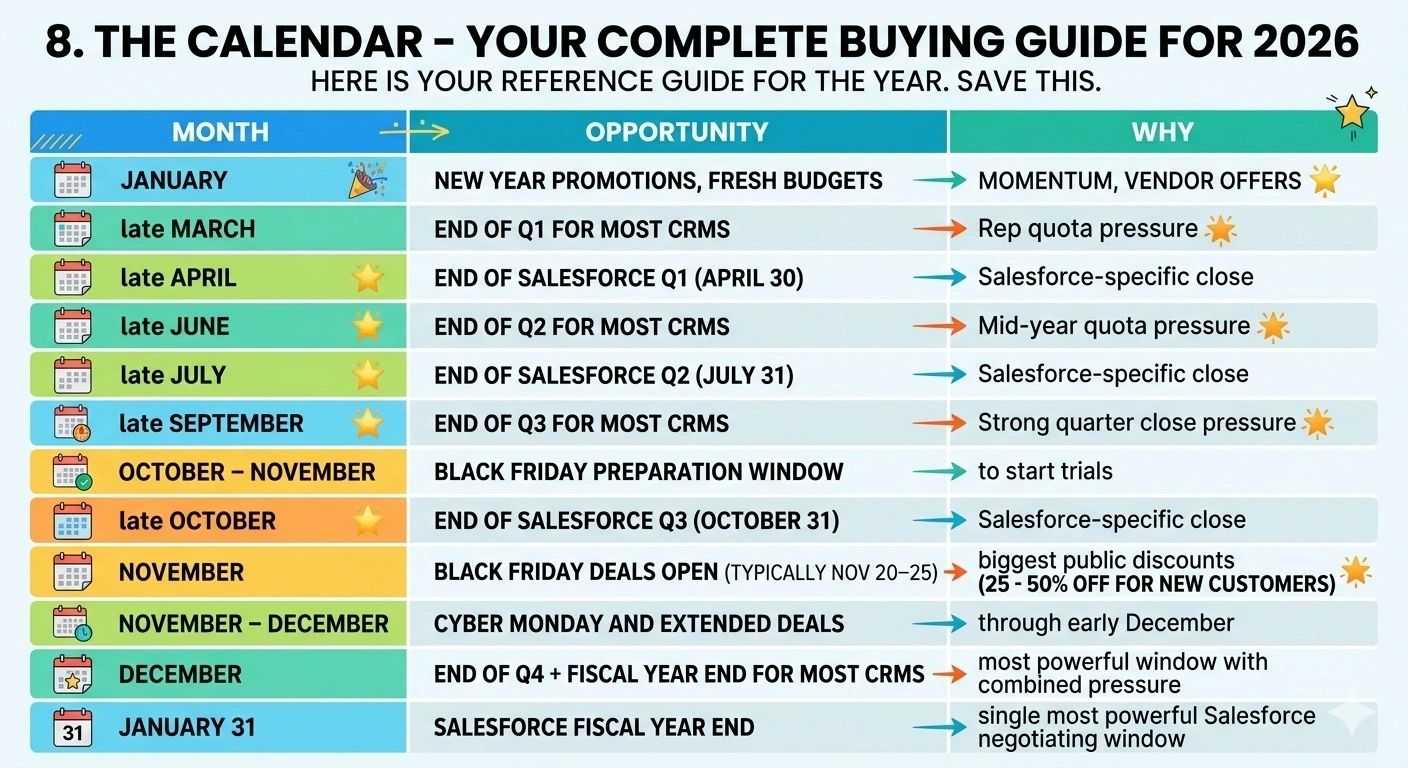
9. Frequently Asked Questions
Is Black Friday genuinely the best time to buy CRM software?
For new customers looking for the biggest publicly available discount, yes - CRM software Black Friday deals are real and meaningful, with discounts of 25 to 50 percent on annual plans from major platforms. The important caveat is that these deals require annual commitment and are almost always for new customers only. Start your trial in October so you arrive at Black Friday ready to decide rather than still evaluating.
Can I get a CRM discount outside of Black Friday?
Yes - consistently. End of quarter timing, multi-year commitments, competitive quotes, startup pricing programs, and case study offers are all routes to meaningful discounts that work year-round. The best time to buy CRM software is not just one window - it is any moment where you have leverage, preparation, and a clear ask.
How do I know when a vendor's quarter ends?
Most CRM vendors run calendar quarters ending March 31, June 30, September 30, and December 31. Salesforce is the notable exception - their fiscal year ends January 31, making late January their single most powerful buying window. When in doubt, ask your sales rep directly. They will tell you.
How much can I realistically save by timing my CRM purchase?
The range is genuinely wide. Annual billing alone saves 10 to 51 percent depending on the platform. Black Friday adds 25 to 50 percent on top for new customers. End of quarter timing can add another 15 to 20 percent through negotiation. Multi-year commitments unlock further reductions. A buyer who combines good timing, competitive quotes, and an annual commitment can realistically save 35 to 45 percent below standard list price on most major platforms - and that compounds over the lifetime of the contract.
Do existing customers get Black Friday deals too?
Usually not on the headline discount - those are almost always for new signups. However, some vendors offer upgrade deals or add-on promotions for existing customers during Black Friday. It is worth asking your account manager what is available. The better strategy for existing customers is renewal negotiation - starting early, benchmarking against current market pricing, and using the renewal moment as an opportunity to renegotiate rather than auto-renewing at whatever increase the vendor proposes.
10. The Timing Takeaway
The best time to buy CRM software is not a single date on a calendar. It is the intersection of your readiness and the vendor's pressure - and when those two things meet, genuinely significant savings become available.
Black Friday is real and worth planning for. End of quarter is consistent and repeatable. December is the single most powerful buying window for most vendors. And the tactics that work year-round - competitive quotes, multi-year commitments, startup pricing requests - are available to any buyer who knows to ask.
What makes the difference between a buyer who pays list price and one who pays 35 percent less isn't luck or charm. It is preparation. Starting your trial early.
Understanding the vendor's calendar. Having real competing proposals. Arriving at the buying conversation with a specific number and a clear timeline.
You now have the map. The next step is deciding when your business is ready to make the move - and making sure that moment aligns with a window that works in your favour.
Don't waste a good discount on the wrong platform.
See what your HubSpot year one should cost
Two minutes with the assistant gets you an itemized estimate. A free 20-minute call gets you a yes or a no on taking your onboarding fee to $0 — plus the negotiation tips for a deal your size.
Book a free 20-minute callNo obligation. Independent — not a HubSpot partner. Run by RevOps operators whose agency is a certified HubSpot Solutions Partner.
Keep reading
What HubSpot's onboarding fee actually buys you
HubSpot's mandatory onboarding fee runs from $1,500 to $7,000 depending on the hub and tier. Here is what is inside it, when it is worth paying, and the two situations where a partner can deliver the same scope instead.

Annual vs Monthly CRM Plans: Which Saves You More Money Long-Term
Annual CRM billing saves 15-40 percent, but locks you in. The real numbers per platform, when the discount is worth it, and when monthly is the safer buy.