HubSpot vs Salesforce vs Zoho: Who Wins on Value

There are CRM comparisons that exist to confirm what you have already decided. You have probably read a few of them this week. This one is going to be different.
The HubSpot vs Salesforce vs Zoho decision is genuinely one of the most important software choices a growing business makes - and it deserves a conversation, not a checklist. Because the real gap between these three platforms isn't features. It is philosophy. It is how each platform thinks about pricing, about AI access, about what a sales team actually needs to do their best work. It's whether your team will be up and running in a week or still in implementation six months later.
And here is the thing nobody says loudly enough: getting this wrong is expensive in ways that don't show up on a spreadsheet. It costs your team their confidence in the tools they are supposed to rely on. It creates data that no one quite trusts. It builds a kind of quiet friction that compounds - until the day you decide to migrate, and realise that switching costs are always higher than staying put.
What follows is the honest version of this comparison. Written for the person making the decision, not the person selling the platform.
1. Three Platforms, Three Price Points, One Question
These three platforms represent three distinct positions in the market - and that positioning is deliberate.
Zoho CRM sits at the accessible end - deep functionality, genuine AI, and the most competitive pricing in this comparison. Starting from €14/user/month with no mandatory onboarding fee and no credit system governing AI access, it is built for businesses that want enterprise-grade capability without the enterprise price tag.
HubSpot occupies the connected middle - a unified platform where marketing, sales, and service share one database, one timeline, and one AI layer. Fast to adopt, intuitive to use, and genuinely powerful at the Professional and Enterprise tiers. The price reflects the integration quality.
Salesforce commands the top end - the world's most customizable CRM with the most powerful AI infrastructure available in 2026. It holds approximately 21.8% of the global CRM market for a reason. But that power comes with a price, a learning curve, and an implementation investment that not every business is ready for.
The value question isn't which platform has the most features. It is which platform's strengths are worth paying for - at your current stage, for your specific team.
2. The Framework That Determines Value
Before we compare a single feature, here is the framework that makes this decision clear.
Value in a CRM isn't price divided by features. It is three things working together:
Fit - Does this platform solve the actual problems your business has today, not the problems you imagine having in three years?
Adoption - Will your team use it consistently at close to its full capability? A powerful platform used at 20% capacity is poor value. A simpler platform used at 90% capacity is excellent value.
Total cost - Not just the subscription. The onboarding fee, the implementation time, the admin overhead, the integrations, and the cost of switching if you get it wrong.
Apply that lens to the HubSpot vs Salesforce vs Zoho comparison and the right answer for your business becomes significantly clearer than any feature table can show. 
3. What Each Platform Delivers at Every Budget Level
At Zero Cost
All three platforms offer something at zero - but what they offer is very different.
Zoho CRM Free supports up to three users with core contact management, lead and opportunity tracking, basic reporting, and essential workflow tools. It is genuinely functional for a micro-business or a team testing the platform before committing.
HubSpot Free is the most generous free CRM in the market - unlimited contacts, deal pipelines, email tracking, meeting scheduling, live chat, and Breeze Copilot AI available from day one. For a small team that needs a real CRM without spending anything, HubSpot's free tier is hard to beat.
Salesforce Free Suite supports up to two users with basic CRM, lead management, and - as of March 2026 - Agentforce basics built in. AI record summaries and Draft with AI email functionality are included at no additional cost. The two-user limit makes it more of an extended trial than a working team solution.
At Entry Paid Level
Zoho Standard at €14/user/month - workflows, AI agents via the Zia Agents Store, cadences, dashboards, sales forecasting, and core Zia intelligence. No credit system. No add-on required for most AI features. Genuinely functional from the first month.
HubSpot Starter at $20/user/month - removes HubSpot branding, basic automation, and 500 AI credits per month. The AI experience at this level is limited - Breeze Copilot works, but the autonomous agents and advanced features require Professional.
Salesforce Starter Suite at $25/user/month - full CRM, email marketing, AI record summaries, and a pre-built Employee Agent. Notable value at this tier given the Agentforce inclusion, though advanced pipeline and customization require Pro Suite at $100/user/month.
At the Professional Mid-Tier
This is where the meaningful capability gap opens between the three platforms - and where the pricing gap becomes most striking.
Zoho Enterprise at €40/user/month unlocks the full Zia AI suite - AI sales assistant, journey orchestration, territory management, custom functions, and the complete Zia Agents Store with pre-built SDR, Deal Analyzer, Sales Coach, and Revenue Growth Specialist agents. No credit system. No add-on fees for core AI. The most complete mid-tier AI package in this comparison per dollar spent.
HubSpot Sales Hub Professional at $100/user/month - plus the mandatory $1,500 onboarding fee - unlocks predictive lead scoring, conversation intelligence, Breeze Agents (on 5,000 credits/month that don't roll over), advanced automation, and revenue forecasting. Marketing Hub Professional is a separate product starting at $800/month.
Salesforce Pro Suite at $100/user/month - sales quoting, forecasting, AppExchange access, and greater customization. Full Agentforce capability requires Enterprise at $175/user/month or the Agentforce add-on at $125/user/month on top.
4. The AI Showdown - Breeze vs Agentforce vs Zia
This is the section that matters most in 2026. AI is no longer a differentiator between CRM and no-CRM - it is a differentiator between CRMs. Here is what each platform actually brings.
HubSpot Breeze - Broad, Accessible, Integrated
Breeze Copilot available on all plans including Free. Breeze Agents at Professional level - Prospecting Agent, Content Agent, Customer Agent - pre-built, ready to deploy, no engineering required. Predictive lead scoring and conversation intelligence on Sales Hub Professional. Revenue forecasting from pipeline behavior. AI email writing throughout.
The strength is integration - because everything runs on one database, every AI insight connects to the complete customer picture. The constraint is the credit system: 5,000 credits per month on Professional, no rollover, 100 credits per Customer Agent conversation.
Salesforce Agentforce - The Highest Ceiling
Agent Builder for custom AI agents from scratch, connected to any data source. Always-on Prospecting identifies, enriches, and prioritizes leads 24/7. Account Management AI synthesizes every customer touchpoint before meetings. Agentforce Voice for natural phone conversation. Agentic Enterprise Search across 200+ external data sources. The Spring '26 release added Sales Workspace - a unified hub for reps combining AI agents, analytics, and predictive insights.
The strength is customization and ceiling. The constraint is cost - Enterprise tier required for most advanced Agentforce features, plus consumption-based pricing at $2/conversation or $500/100,000 Flex Credits on top of subscription.
Zoho Zia - The Underestimated Powerhouse
Here is where the HubSpot Salesforce Zoho comparison surprises most people. Zia covers more ground than its pricing suggests.
Pre-built AI Agents from the Zia Agents Store - SDR, Deal Analyzer, Sales Coach, Follow-up Scheduler, Quote Generator, Revenue Growth Specialist - deployable immediately without engineering. Zia Agent Studio for custom agent building using natural language. Churn prediction scoring every customer record. Predictive lead and deal scoring. AI forecasting with gap analysis and prescriptive recommendations. Voice of the Customer dashboards synthesizing sentiment across emails, surveys, and support tickets. Email sentiment, emotion, and intent analysis. Anomaly detection across workflows and sales patterns. Business intelligence presentations generated monthly.
The strength is breadth at price. The constraint is that AI features reach full power as your data matures in the platform, and the user experience around some Zia features requires more configuration than Breeze or Agentforce. 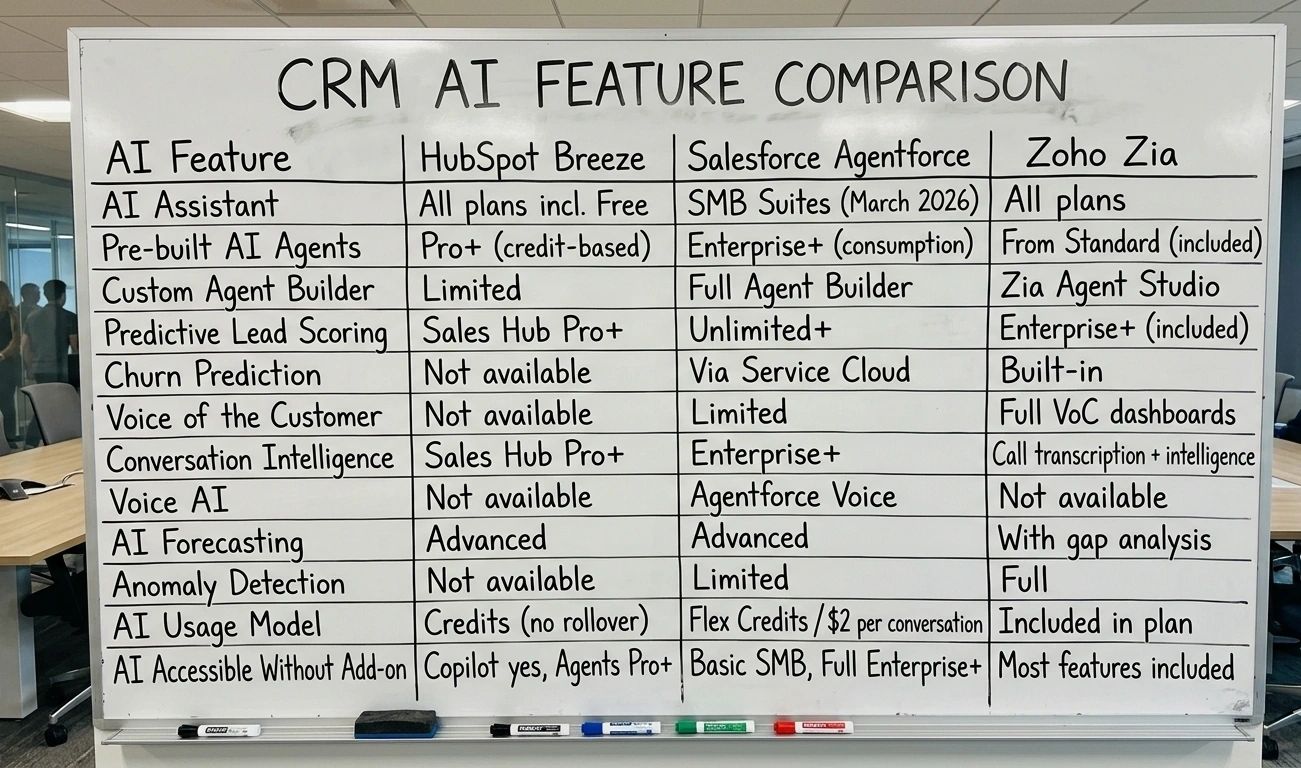
5. Where Each Platform Wins and Where It Doesn't
Rather than a generic strengths list, here is where each platform creates genuine, measurable advantage - and where it falls short honestly.
HubSpot wins decisively on: Speed of adoption, marketing and sales data unification, inbound marketing depth, ease of AI deployment without engineering resources, and the quality of its 1,700+ native integrations. For businesses where the gap between marketing and sales costs revenue every day, HubSpot's architecture pays for itself.
HubSpot struggles with: Deep process customization beyond standard workflows, ERP integration for combined operational and CRM data, and cost escalation as teams grow - the per-seat model and contact tier pricing compound quickly at scale. Mandatory onboarding fees add meaningfully to year-one costs.
Salesforce wins decisively on: Customization depth, enterprise AI capability, the breadth of the AppExchange ecosystem (5,200+ integrations), and the ability to build almost any sales or service workflow imaginable. For large enterprises with technical resources and complex processes, the ceiling is genuinely unmatched.
Salesforce struggles with: Total cost of ownership for mid-market teams, implementation complexity without dedicated admin resources, and the fragmentation of marketing as a separate product purchase. The learning curve is real and the configuration investment is significant.
Zoho wins decisively on: Value per dollar at every tier, AI breadth included in plan pricing, customization flexibility without mandatory developer involvement, and the depth of the wider Zoho ecosystem for businesses wanting to expand beyond CRM. The best value CRM for growing businesses 2026 conversation starts and often ends with Zoho for budget-conscious teams.
Zoho struggles with: User experience polish compared to HubSpot, native marketing automation depth, and the time investment required to reach full platform capability. Businesses that need fast adoption without configuration overhead may find the learning curve challenging.
Still Figuring Out Which Level Your Business Is At?
The answer is usually clearer than it feels right now. Few questions, two minutes.
Work out which platform fits your business
6. Running the Numbers - Real Costs for Real Teams
Let's apply real numbers to two common team sizes. This is where the HubSpot vs Salesforce vs Zoho value gap becomes most visible. 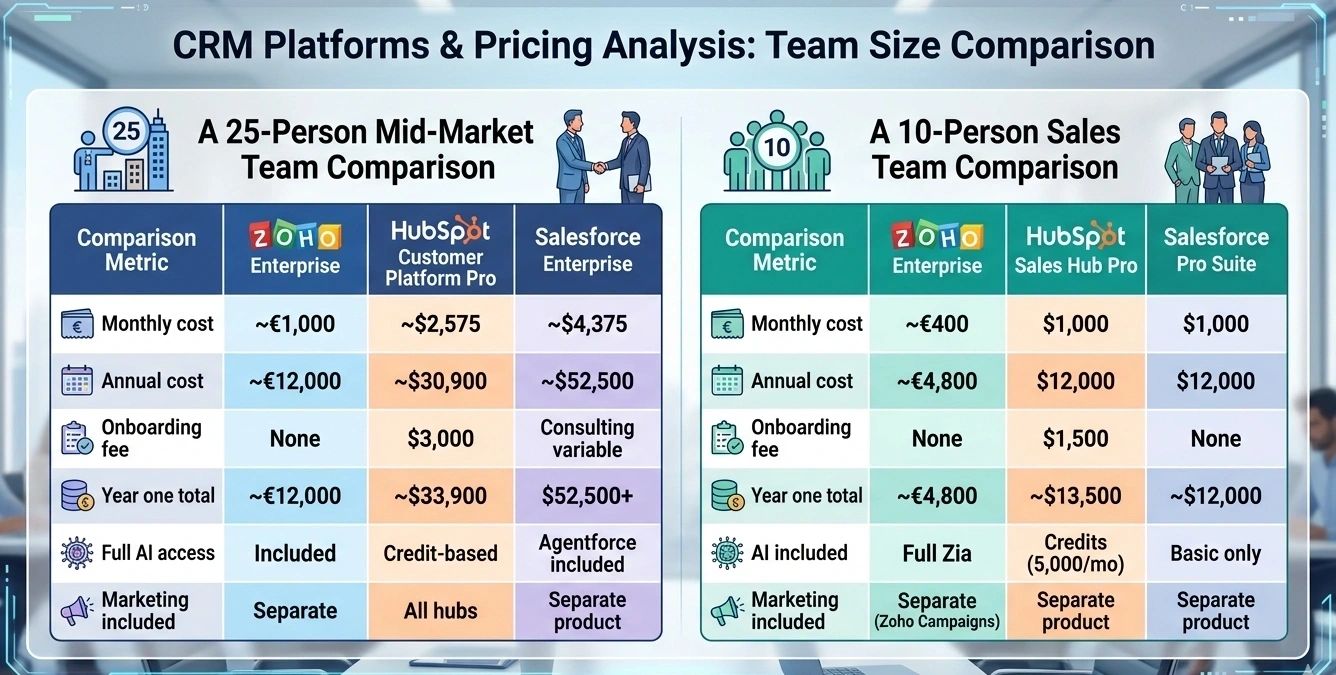
The numbers tell a clear story. At both team sizes, Zoho delivers the most capability per dollar spent. HubSpot justifies its premium through unified marketing inclusion and adoption speed. Salesforce's enterprise investment becomes defensible only when the customization depth and AI ceiling are genuinely leveraged - which requires the right organizational infrastructure to support it.
7. The Value Verdict by Business Type
You get the best value from Zoho CRM when: Your team has the patience to configure a platform properly and the result is a CRM that fits your exact workflow rather than a generic one you adapt to. Budget is a genuine strategic consideration and you need the best value CRM for growing businesses 2026 that does not sacrifice AI capability for affordability. You are considering expanding into the wider Zoho ecosystem - Campaigns, Desk, Analytics - making the investment even more efficient over time.
[For the full Zoho CRM breakdown against HubSpot, our dedicated HubSpot vs Zoho comparison goes deeper on every feature.]()
You get the best value from HubSpot when: Marketing and sales alignment is a daily operational priority and you need both teams working from identical data without integration overhead. Your team needs to be productive fast - HubSpot's adoption curve is the shortest of the three. You are running an inbound marketing motion and want content, SEO, and campaigns connected to your CRM data natively.
You get the best value from Salesforce when: Your organization has the technical resources to configure and maintain a complex platform - and the sales process complexity to justify it. Territory management, advanced forecasting, multi-stakeholder deal orchestration, and Voice AI are capabilities you will genuinely use. At enterprise scale, Salesforce's customization and AI ceiling deliver ROI that simpler platforms can not match.
[For the full HubSpot vs Salesforce breakdown, our dedicated comparison covers the enterprise picture in detail.]()
8. Five Things Worth Knowing Before You Sign Anything
1. Zoho's AI improves significantly with data maturity.
Zia's predictive features - lead scoring, churn prediction, deal forecasting - become more accurate as your historical data builds in the platform. Factor in a 6–12 month maturation period before predictions reach full reliability if you're migrating from another system.
2. HubSpot's credit system needs planning.
At Professional level, 5,000 AI credits per month sounds generous until you model actual usage. The Customer Agent costs 100 credits per conversation - roughly 50 free AI-resolved interactions per month. Heavy agent usage requires additional credit packs at $10 per 1,000 credits. Credits do not roll over.
3. Salesforce's true cost includes implementation.
The subscription price is the starting point, not the full picture. Enterprise implementations typically involve either a dedicated Salesforce admin ($75,000–$120,000 salary) or consulting fees ranging from $20,000 to $100,000+. For mid-market businesses without that infrastructure, the platform's complexity creates hidden costs that erode the value calculation.
4. All three platforms have free trials - use them.
Zoho offers 15 days free on Standard through Enterprise and 30 days on Ultimate. HubSpot's free plan is genuinely permanent - not time-limited. Salesforce offers a 30-day trial. Testing your actual workflows before committing is the single most effective way to validate the value assessment.
5. The switching cost is real.
Data migration, team retraining, integration rebuilding, and productivity loss during transition are all costs that do not appear on any pricing page. The right platform chosen carefully is almost always better value than the right platform chosen quickly and switched six months later.
9. Questions That Come Up Every Time
Which is cheapest - HubSpot, Salesforce, or Zoho?
Zoho is the most affordable at every equivalent tier - starting from €14/user/month with no mandatory onboarding fee and AI included in plan pricing. In the HubSpot Salesforce Zoho comparison on price alone, Zoho wins at every scale. HubSpot and Salesforce are comparable at the mid-market level before enterprise pricing kicks in.
Does Zoho CRM have AI as good as HubSpot or Salesforce?
In terms of breadth - yes, and it surprises most people. Zia covers churn prediction, Voice of the Customer, anomaly detection, pre-built AI agents, and custom agent building - capabilities that neither HubSpot nor Salesforce match at Zoho's price point. The trade-off is a less polished interface and a steeper configuration curve.
Is Salesforce worth the premium over HubSpot and Zoho?
For enterprises with complex sales cycles, dedicated technical resources, and 50+ users: yes. For mid-market businesses under 50 users without a Salesforce admin: usually not. The capability is real - the question is whether your organization can actually leverage it. That is what determines value.
What is the best value CRM for growing businesses in 2026?
For businesses under 50 people focused primarily on sales pipeline management: Zoho Enterprise delivers extraordinary value. For businesses where marketing and sales integration is the priority: HubSpot's Professional tier justifies its premium. The best value CRM for growing businesses 2026 is always the one whose strengths align with your specific growth motion.
Can I start with Zoho and migrate to HubSpot or Salesforce later?
Yes - and it is a common progression. Many businesses start on Zoho, grow into its full capability, and then evaluate HubSpot or Salesforce when marketing integration or enterprise customization becomes a genuine need rather than an aspiration. Starting where you are and scaling intentionally is almost always better value than buying ahead of your needs.
10. So Which One Is Actually Worth It?
The HubSpot vs Salesforce vs Zoho value question has three honest answers depending on who is asking.
If budget is a real constraint and you need a CRM with genuine AI depth that your team will actually use - Zoho CRM delivers more per dollar than almost anything else at its price point. The configuration investment pays off, and the platform scales further than most businesses expect.
If you are building a connected revenue operation where marketing, sales, and service need to work from the same data and you want AI tools your team can use from day one - HubSpot's investment is justified. The adoption speed, the integration quality, and the unified architecture create compounding value over time.
If you are an enterprise with the scale, the technical resources, and the process complexity to leverage what Salesforce is actually built for - the ceiling it offers is genuinely unmatched. At that scale, the investment becomes competitive rather than expensive.
The worst value in any of these three platforms comes from choosing the wrong one for your business model. A tool your team does not use, a platform you can't configure properly, or a subscription that covers capabilities you will never need none of those are good deals at any price.
The Right CRM Is Worth Every Penny. The Wrong One Costs You More Than Money.
Knowing the options is one thing. Knowing which option is yours is another. Let's settle that now.
See what your HubSpot year one should cost
Two minutes with the assistant gets you an itemized estimate. A free 20-minute call gets you a yes or a no on taking your onboarding fee to $0 — plus the negotiation tips for a deal your size.
Book a free 20-minute callNo obligation. Independent — not a HubSpot partner. Run by RevOps operators whose agency is a certified HubSpot Solutions Partner.
Keep reading
What HubSpot's onboarding fee actually buys you
HubSpot's mandatory onboarding fee runs from $1,500 to $7,000 depending on the hub and tier. Here is what is inside it, when it is worth paying, and the two situations where a partner can deliver the same scope instead.

Annual vs Monthly CRM Plans: Which Saves You More Money Long-Term
Annual CRM billing saves 15-40 percent, but locks you in. The real numbers per platform, when the discount is worth it, and when monthly is the safer buy.