HubSpot vs Klaviyo vs SalesForce: Best CRM Value

Value is the most misunderstood word in CRM conversations.
When people ask which platform gives the best bang for their buck in the HubSpot vs Klaviyo vs Salesforce debate, they are usually comparing price tags. But price without context is just a number. What actually matters is what you get per dollar - and whether those dollars are buying capabilities your business will genuinely use.
These three platforms are all excellent. They are also all designed for fundamentally different businesses. Understanding that difference is how you stop paying for features you don't need and start investing in ones that move your numbers.
Here is the real value breakdown.
1. The Value Question Nobody Asks Properly
Most value comparisons look at price. The right value question looks at return on fit.
A $15,000/year platform that your team uses at 90% capacity delivers more value than a $5,000/year platform your team uses at 20%. The best value CRM in 2026 is not the cheapest one - it is the one whose strengths align with how your business actually makes money.
With that lens, HubSpot vs Klaviyo vs Salesforce becomes a much cleaner conversation. Each platform has a distinct value proposition built for a distinct type of business:
- Salesforce - maximum power and customization for enterprises willing to invest in configuration and administration
- HubSpot - unified marketing, sales, and service for growing businesses that want capability without complexity
- Klaviyo - the deepest AI-driven marketing automation for B2C and ecommerce businesses driving revenue through email, SMS, and lifecycle campaigns
Know your business model. That's where the value comparison starts. 
2. The Quick Verdict - Before We Go Deeper
Three platforms. Three completely different value propositions. And one of them is almost certainly a poor fit for your business - even if the feature list looks impressive on paper.
The thing about HubSpot vs Klaviyo vs Salesforce is that comparing them on price alone misses the point entirely. A $20/month platform that does exactly what your business needs will always outperform a $1,500/month platform you're using at 30% capacity. And a $1,500/month platform that's genuinely built for your operation will pay for itself faster than a cheaper tool that creates friction every single day.
What actually determines value here isn't the monthly fee - it is how well each platform's strengths align with how your business makes money.
Klaviyo was built for businesses that grow through customer lifetime value, email sequences, and ecommerce automation. If that's your model, it's hard to beat.
HubSpot was built for businesses that need marketing, sales, and service operating as one connected system. If alignment across your revenue team is the priority, that architecture matters more than almost anything else.
Salesforce was built for enterprises with the scale, complexity, and technical resources to leverage the most powerful CRM infrastructure in the market. If you have the team to configure it properly, the ceiling is extraordinary.
Three different bets. Three different returns. The rest of this blog shows you exactly what each one delivers - and how to know which bet is yours.
3. What You Get From Each Platform at Entry Level
Entry-level plans reveal a platform's values more clearly than anything else - because this is where they decide what to include without payment and what to lock behind a paywall.
Klaviyo's free plan is genuinely generous. Up to 250 contacts, 500 email sends per month, 150 SMS credits, basic automation, the full drag-and-drop editor, and access to Aura - Klaviyo's AI marketing agent for content generation. For a small ecommerce brand just getting started, this is a real working platform, not a stripped-down demo. The moment you move to the $20/month Email plan, you unlock predictive analytics, full AI content generation, and send-time optimization.
HubSpot's free plan covers core CRM with unlimited contacts, deal tracking, email tracking, meeting scheduling, and Breeze Copilot - its AI assistant. It is the most functional free CRM available in the market. Marketing, sales, and service all have free-tier access, making it genuinely useful for small teams before any investment is required.
Salesforce's entry point changed meaningfully in 2026. Free Suite now includes basic CRM for up to 2 users with Agentforce basics built in - AI record summaries and Draft with AI email functionality at no additional consumption cost. Starter Suite at $25/user/month extends this with full AI record summaries, a pre-built Employee Agent, and basic sales automation.
Entry-level value winner: Klaviyo for ecommerce businesses. HubSpot for everyone else. Salesforce's new SMB AI inclusion is notable, but the 2-user Free Suite limit keeps it firmly in trial territory.
4. Where the AI Money Actually Goes
This is the section that matters most for 2026 - because AI is now the primary differentiator between platforms at every price tier.
Klaviyo's AI is included in plan pricing from the $20/month tier. You don't pay extra for it - you just pay for contacts and volume. What you get: Marketing Agent (autonomous campaign creation from a URL), Composer (full campaign and flow generation from a single prompt - just launched in March 2026), predictive analytics across every contact profile (CLV, churn probability, next purchase date), Segments AI for natural language audience building, and send-time optimization. The AI gets smarter with more data, and it is available to every paying customer from day one.
HubSpot's AI via Breeze is structured differently. Basic Breeze Copilot is free. The autonomous agents - Prospecting Agent, Content Agent, Customer Agent - require Professional plans and run on credits: 5,000 per month on Professional, no rollover. The Customer Agent costs 100 credits per conversation, which gives you approximately 50 AI-resolved conversations per month before additional spend. Predictive lead scoring and conversation intelligence are Sales Hub Professional features. The AI is broader than Klaviyo's - covering sales, marketing, service, and content - but the usage model means heavy AI users need to monitor their credit consumption carefully.
Salesforce's AI through Agentforce is the most powerful and the most expensive. Enterprise tier is required for the full Agentforce suite - at $175/user/month. The consumption model charges $2 per conversation or $500 per 100,000 Flex Credits. For enterprises using AI at scale, the Agentforce 1 Sales bundle at $550/user/month includes unmetered usage. The capability ceiling is genuinely higher than either HubSpot or Klaviyo - custom agent building, Voice AI, always-on prospecting, and agentic enterprise search across 200+ data sources. The trade-off is cost and configuration complexity.
AI value winner: Klaviyo for ecommerce marketing AI per dollar spent. HubSpot for full-funnel AI breadth. Salesforce for enterprises needing maximum customization and AI depth.
5. The Full Feature Value Comparison
Before we get to pricing, it helps to see where each platform leads, where it lags, and where it simply is not designed to compete. Because the best value CRM 2026 is not the one with the most green ticks - it is the one whose green ticks match what your business actually needs.
Here is an honest read across the three platforms:
Where HubSpot leads the group: Unified data model connecting marketing, sales, and service. Email marketing built into every plan. Breeze Copilot available from Free. Sales pipeline AI including lead scoring, conversation intelligence, and revenue forecasting. 1,700+ native integrations working without middleware.
Where Klaviyo leads the group: Ecommerce-specific AI including CLV prediction, churn scoring, and replenishment flows. Predictive analytics available from the $20/month plan - no Professional tier required. SMS and WhatsApp as core features rather than add-ons. Email pricing based on volume rather than seats, making it dramatically more affordable for large contact lists.
Where Salesforce leads the group: The highest AI ceiling of the three - Agentforce Voice, agentic enterprise search across 200+ external sources, and fully custom agent building. 5,200+ AppExchange integrations. The most sophisticated conversation intelligence and deal forecasting at enterprise scale. 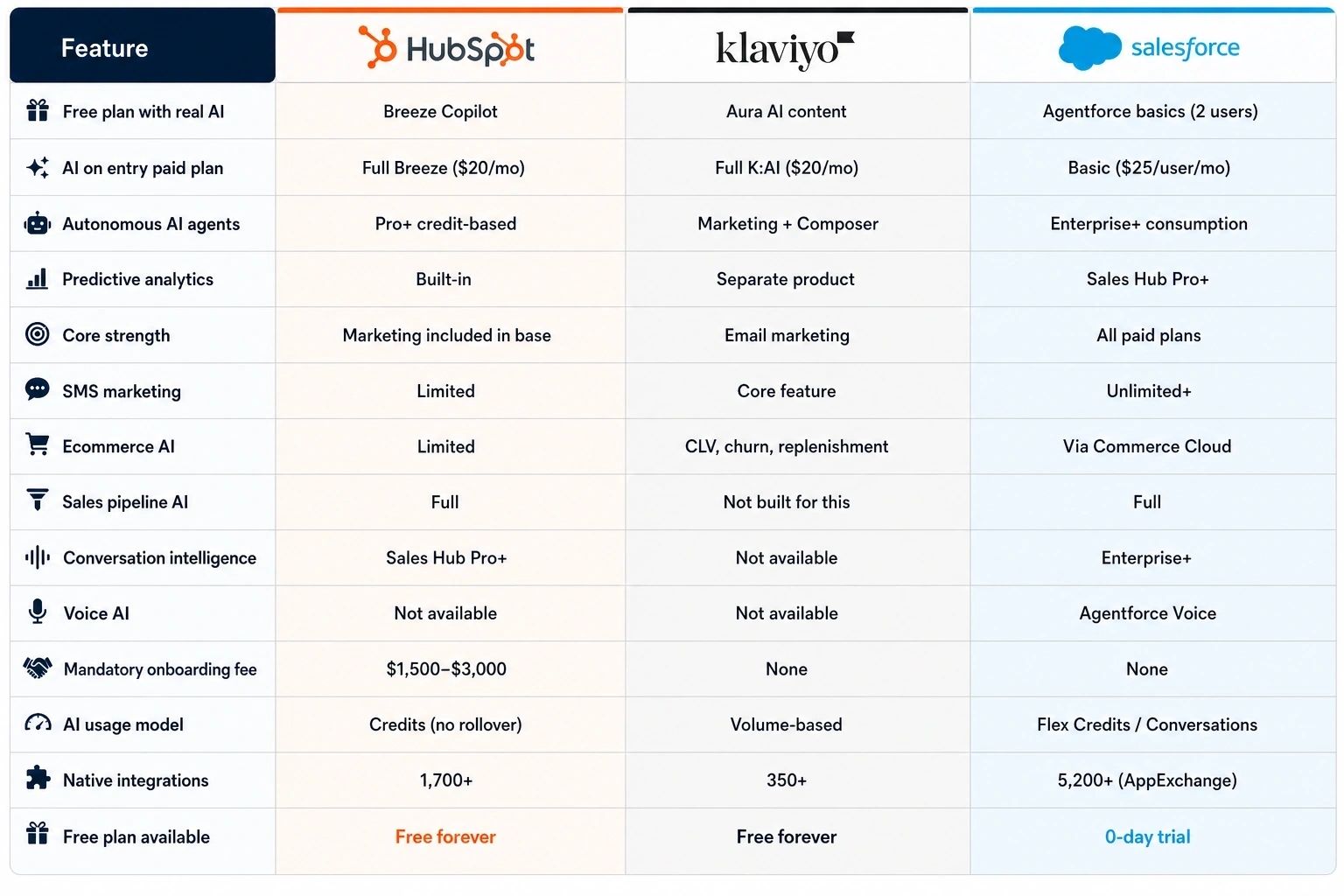
The pattern that emerges tells the story clearly. Klaviyo wins on marketing depth and accessibility for ecommerce businesses. HubSpot wins on breadth and integration for growing B2B teams. Salesforce wins on ceiling and customization for enterprises with the resources to reach it.
No platform is weak - they are just strong in different lanes. The value question is which lane your business is actually running in.
6. The Pricing Reality - What Each Platform Costs by Business Type
Let's apply real numbers to three common business profiles.
A 5-person ecommerce team sending 50,000 emails/month to 10,000 contacts:
- Klaviyo Email plan: approximately $150/month - full AI, predictive analytics, automation included
- HubSpot Marketing Hub Professional: $800/month + $3,000 onboarding = $12,600 year one
- Salesforce Marketing Cloud Next Growth: $1,500/month flat
- Value winner: Klaviyo - by a significant margin
A 10-person B2B sales and marketing team:
- HubSpot Sales Hub Professional (10 users): $1,000/month + $1,500 onboarding = $13,500 year one
- HubSpot Customer Platform Professional: $1,450/month + $3,000 onboarding = $20,400 year one
- Salesforce Sales Cloud Pro Suite (10 users): $1,000/month annual billing
- Klaviyo: not the right tool for this use case
- Value winner: HubSpot or Salesforce Pro Suite - comparable at this scale
A 50-person enterprise with complex sales cycles:
- Salesforce Enterprise (50 users): approximately $8,750/month - full Agentforce, conversation intelligence, advanced pipeline
- HubSpot Sales Hub Enterprise (50 users): approximately $7,500/month + enterprise onboarding
- Klaviyo: not designed for this use case
- Value winner: Salesforce - the capability per dollar at enterprise scale justifies the investment
Not Sure Which Tier Your Business Sits In?
The fastest path to the right answer is a few honest questions about your team and your goals.
Get your HubSpot year-one estimate in two minutes → 
7. Which One Wins for Your Business Model
Choose Klaviyo when your revenue engine runs on email, SMS, and customer lifecycle marketing. You are B2C, ecommerce, or DTC. You want the best AI-driven marketing automation for the best price - and you do not need a sales pipeline. The HubSpot vs Klaviyo vs Salesforce value conversation ends here for ecommerce brands. Klaviyo is the best value CRM 2026 for this specific motion.
[For a deeper look at how Klaviyo stacks up against HubSpot specifically, our full HubSpot vs Klaviyo comparison covers every detail.]()
Choose HubSpot when you are a growing B2B or mixed business where marketing and sales need to share data and move fast. You want AI that works immediately, a platform your team adopts without months of training, and one subscription that covers marketing, sales, and service without separate product purchases. For the HubSpot Klaviyo Salesforce comparison at the mid-market level, HubSpot consistently delivers the broadest value per dollar.
[See how HubSpot compares to the other enterprise giant in our HubSpot vs Salesforce breakdown.]()
Finally Salesforce will suit you when you are an enterprise with a dedicated technical team, complex multi-stakeholder sales cycles, and the organizational capacity to configure and maintain a powerful platform. The AI ceiling is higher than either HubSpot or Klaviyo. The customization depth is unmatched. And for businesses where those capabilities translate directly into revenue, the investment is justified. This is the best value CRM 2026 when your scale demands it.
8. Frequently Asked Questions
Which is cheaper - HubSpot, Klaviyo, or Salesforce?
Klaviyo is the most affordable for email and marketing-focused businesses, starting from $20/month with full AI included. HubSpot and Salesforce are comparable at the mid-market level - both around $85–$100/user/month for meaningful functionality. Salesforce becomes more expensive at enterprise tier but delivers more capability. In the HubSpot vs Klaviyo vs Salesforce pricing comparison, Klaviyo wins for marketing-focused businesses at every scale.
Does Klaviyo have sales CRM features?
No - Klaviyo is built for B2C marketing, not B2B sales pipeline management. It has no deal stages, lead scoring for sales teams, or conversation intelligence. For the HubSpot Klaviyo Salesforce comparison on sales features, HubSpot and Salesforce compete while Klaviyo serves a different use case entirely.
Is HubSpot's AI better than Salesforce's?
They are designed for different priorities. HubSpot's Breeze is more accessible, faster to deploy, and included across more plan tiers. Salesforce's Agentforce is more customizable, more powerful at enterprise scale, and capable of deeper integration with external systems. For most mid-market businesses, HubSpot's AI delivers better immediate value. For enterprises with technical resources, Salesforce's ceiling is higher.
What is the best value CRM in 2026?
It depends entirely on your business model. For ecommerce: Klaviyo. For growing B2B teams: HubSpot. For complex enterprise sales: Salesforce. The best value CRM 2026 is the one whose strengths align with how your business generates revenue - not the one with the lowest monthly fee.
Can I use Klaviyo and HubSpot together?
Yes - and many businesses do. HubSpot handles CRM, pipeline management, and sales automation while Klaviyo handles email marketing and ecommerce lifecycle campaigns. They integrate natively. If your business spans both B2B sales and ecommerce, running both is a legitimate approach - just factor in the combined cost.
9. The Bottom Line on Value
The HubSpot vs Klaviyo vs Salesforce value question has a clear answer once you stop comparing price and start comparing fit. 
Klaviyo delivers extraordinary marketing AI value for ecommerce businesses - more capability per dollar in that specific lane than either of its competitors.
HubSpot delivers the most complete mid-market platform for growing B2B and mixed businesses - unified, fast, and increasingly powerful with Breeze AI at every level. Salesforce delivers the highest ceiling for enterprises with the resources to reach it - Agentforce is genuinely impressive, and for the right organization, every dollar comes back.
The worst CRM decision you can make in 2026 is choosing based on a feature comparison without first answering: what kind of business am I, and what does growth look like for the next three years?
Answer that, and the platform that gives you the best bang for your buck becomes obvious.
Your Business Already Knows the Answer
Most businesses pick the wrong platform because they compare features instead of fit. Let's make sure you don't..
Find out which CRM gives you the best valu
See what your HubSpot year one should cost
Two minutes with the assistant gets you an itemized estimate. A free 20-minute call gets you a yes or a no on taking your onboarding fee to $0 — plus the negotiation tips for a deal your size.
Book a free 20-minute callNo obligation. Independent — not a HubSpot partner. Run by RevOps operators whose agency is a certified HubSpot Solutions Partner.
Keep reading
What HubSpot's onboarding fee actually buys you
HubSpot's mandatory onboarding fee runs from $1,500 to $7,000 depending on the hub and tier. Here is what is inside it, when it is worth paying, and the two situations where a partner can deliver the same scope instead.

Annual vs Monthly CRM Plans: Which Saves You More Money Long-Term
Annual CRM billing saves 15-40 percent, but locks you in. The real numbers per platform, when the discount is worth it, and when monthly is the safer buy.