HubSpot vs Kajabi - Match the Platform to Your Business Model
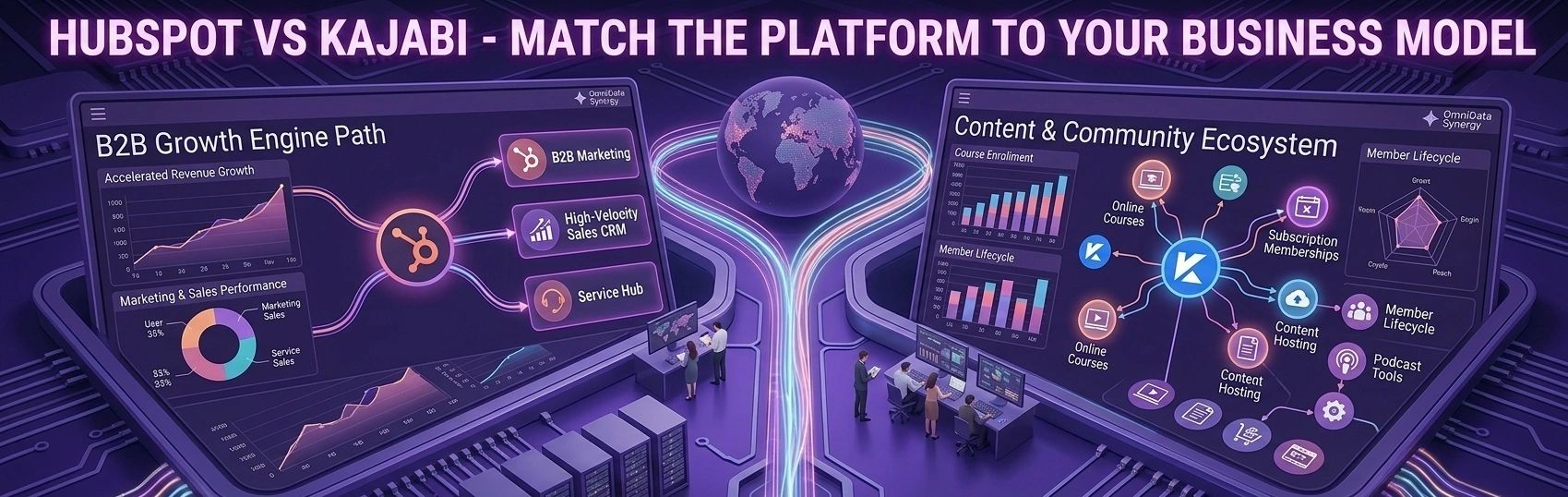
Most comparisons of HubSpot vs Kajabi treat them as two versions of the same thing. According to CRM Discount, they're not. And the moment you understand that, this decision gets significantly easier.
HubSpot is a customer relationship management platform - built for businesses that need to manage sales pipelines, run marketing campaigns, and align teams around revenue. Kajabi is a creator commerce platform - built for experts, coaches, and educators who sell knowledge and want every tool they need in one place.
If you are reading this trying to figure out which one belongs in your business, the answer isn't about features. It is about what kind of business you are actually running.
1. The Thing Nobody Mentions Upfront
Here is the honest framing before we go any further.
Kajabi is not a CRM. It does not have a sales pipeline. It does not have deal stages or lead scoring or conversation intelligence. It was never designed for a business development team managing prospects through a B2B funnel.
HubSpot is not a creator platform. It does not help you build courses, host communities, manage membership sites, or sell coaching programs. You won't find a content repurposing studio or an AI that interviews you about your expertise to surface product ideas.
The businesses that get into trouble are the ones that try to force one of these platforms to do what the other was built for. The ones that thrive are the ones that match the platform to the business model.
So before anything else - what are you building?
2. Kajabi Explained - One Platform, Every Tool Your Knowledge Business Needs
Kajabi is an all-in-one platform for knowledge businesses. Coaches, course creators, educators, consultants, community builders, and expert entrepreneurs use it to build, sell, and scale without stitching together five different tools.
Over 100,000 creators have built their businesses on Kajabi. Collectively, they have earned over $10 billion in revenue - and Kajabi takes none of it. No revenue share. No percentage of sales. Just a flat monthly subscription that covers everything.
What "everything" looks like in 2026:
Products you can sell: Online courses, coaching programs, memberships, communities, podcasts, newsletters, digital downloads, and live events - all manageable from one dashboard.
Marketing tools included: Email marketing, landing pages, sales funnels, checkout pages, automations, and affiliate programs - no third-party tools required.
New in 2026: Comment-to-DM automation (Instagram and Facebook), AI dubbing in 100+ languages for course videos, cohort courses with structured deadlines, a redesigned checkout with reported conversion lifts of up to 68% for early adopters, and a significantly smarter Cofounder AI - the platform's flagship feature.
Pricing (billed annually):
- Basic - $143/month - 5 products, 2,500 contacts, 1 website, 1 community
- Growth - $199/month - 50 products, 25,000 contacts, advanced automations
- Pro - $399/month - unlimited products, 100,000 contacts, 3 websites, branded mobile app, API access
No mandatory onboarding fee. No credit system. No per-seat charges. No revenue sharing.
3. Cofounder, Ama, and the AI Suite Built for Creators
This is where Kajabi has made its most meaningful investment in 2026 - and it is genuinely different from anything else in this comparison series.
Cofounder - The AI That Actually Knows Your Business
Most AI tools are generic. You give them a prompt, they give you output. They have no idea who you are, what you sell, or who your audience is.
Kajabi Cofounder is different. It is built directly into every Kajabi account with access to your products, your audience data, your business model, and your existing content. When you ask it for help, it's not starting from a blank slate - it is working from your specific context.
Here is what Cofounder does in practice:
Clarity - It interviews you like a real business partner would. It asks what you know, who you serve, and what problems your audience has. From that conversation, it surfaces the courses, coaching programs, and offers you could build - including ones you hadn't thought of yet. For experts who have more ideas than time and no idea where to start, this alone is worth the subscription.
Marketing - Once it knows your business, it writes a copy in your voice. Emails, landing pages, sales pages, subject lines - all generated based on what's actually converting for businesses like yours, adapted to how you communicate. Not template copy. Your copy.
Pricing - It analyses your offers, your audience, and what is working in your space, then recommends pricing, bundles, and upsell paths with reasoning behind each suggestion. No more guessing or anxiety around what to charge.
Direction - Ask anything about your business. Where to focus next. How to position your next launch. What your funnel is missing. It gives you strategic answers grounded in your actual data - not generic advice from a model trained on the entire internet.
Cofounder is included on every Kajabi plan, with no extra cost and no waitlist.
Ama - The Conversational AI Assistant
Ama is Kajabi's in-platform chatbot, accessible from any page in your account. It handles day-to-day content tasks: writing sales emails, drafting blog posts, creating social media captions, generating code, researching topics. Think of it as your always-available writing partner who understands Kajabi's ecosystem.
Ama maintains conversation context as you navigate around your account, so you can move from writing an email to building a landing page without losing the thread of what you were working on.
Creator Studio - Turn One Video Into a Content Library
Creator Studio is Kajabi's content repurposing engine. Feed it a long-form video - a course lesson, a workshop, a podcast episode - and it generates social media clips, blog posts, email drafts, and more. For creators who produce video content and need to extend its reach across channels, this eliminates hours of manual repurposing work every week.
AI Content Assistant and AI Dubbing
The AI content assistant generates complete course outlines, lesson content, landing pages, and sales email sequences from a simple prompt. And in 2026, Kajabi added AI dubbing - transforming your spoken content into translations across 100+ languages, making your courses globally accessible without additional production work.
What Kajabi's AI doesn't do: Sales pipeline intelligence, lead scoring, conversation analysis for sales coaching, revenue forecasting, or B2B marketing automation. The entire AI suite is built around content creation, business strategy for expert businesses, and creator workflows - not sales team management.
4. What HubSpot Brings to the Table
HubSpot is a full-funnel customer platform built for businesses where marketing, sales, and service teams need to operate from one connected system. It started as a marketing tool, grew into a CRM, and now covers the entire revenue operation for businesses of almost any size.
Its core strength is the unified data model - when a prospect fills a form, clicks an email, or visits a page, that information is immediately visible across every hub your team uses. No sync. No lag. One source of truth.
For a creator or coach considering HubSpot, the relevant capabilities are:
Email marketing and automation, landing page builder, forms, lead capture, marketing analytics, and the ability to manage a contact database with behavioral segmentation. For a knowledge business that wants enterprise-grade marketing automation and CRM-level contact management - HubSpot covers that ground well.
Where it falls short for creators: HubSpot has no native course creation, community management, membership hosting, coaching session management, or content repurposing tools. You would need to integrate separate platforms for all of those - which is exactly the fragmented stack that Kajabi was built to replace.
HubSpot's AI Breeze - is embedded throughout the platform:
- Breeze Copilot (all plans, including Free) - AI assistant surfacing contact summaries, deal insights, and next steps
- Breeze Agents (Professional+, credit-based) - Prospecting Agent, Content Agent, Customer Agent running workflows autonomously
- Predictive Lead Scoring (Sales Hub Pro+) - ranks contacts by conversion likelihood
- Conversation Intelligence (Sales Hub Pro+) - transcribes and analyzes sales calls
- AI Email Writing - drafts personalized outreach across Sales and Marketing Hubs
- Revenue Forecasting - probability-weighted pipeline projections
HubSpot pricing for relevant plans:
- Free - basic Breeze Copilot, core CRM
- Marketing Hub Professional - $800/month (3 seats) + $3,000 mandatory onboarding fee
- Sales Hub Professional - $100/user/month + $1,500 mandatory onboarding fee
- Customer Platform Professional - $1,450/month (6 seats) + $3,000 onboarding fee
- AI credits: 5,000/month on Professional - do not roll over month to month
Which One Is Right for You?
If you're building a knowledge business, the fastest path to the right platform is knowing your own business model first.
Get your HubSpot year-one estimate in two minutes → 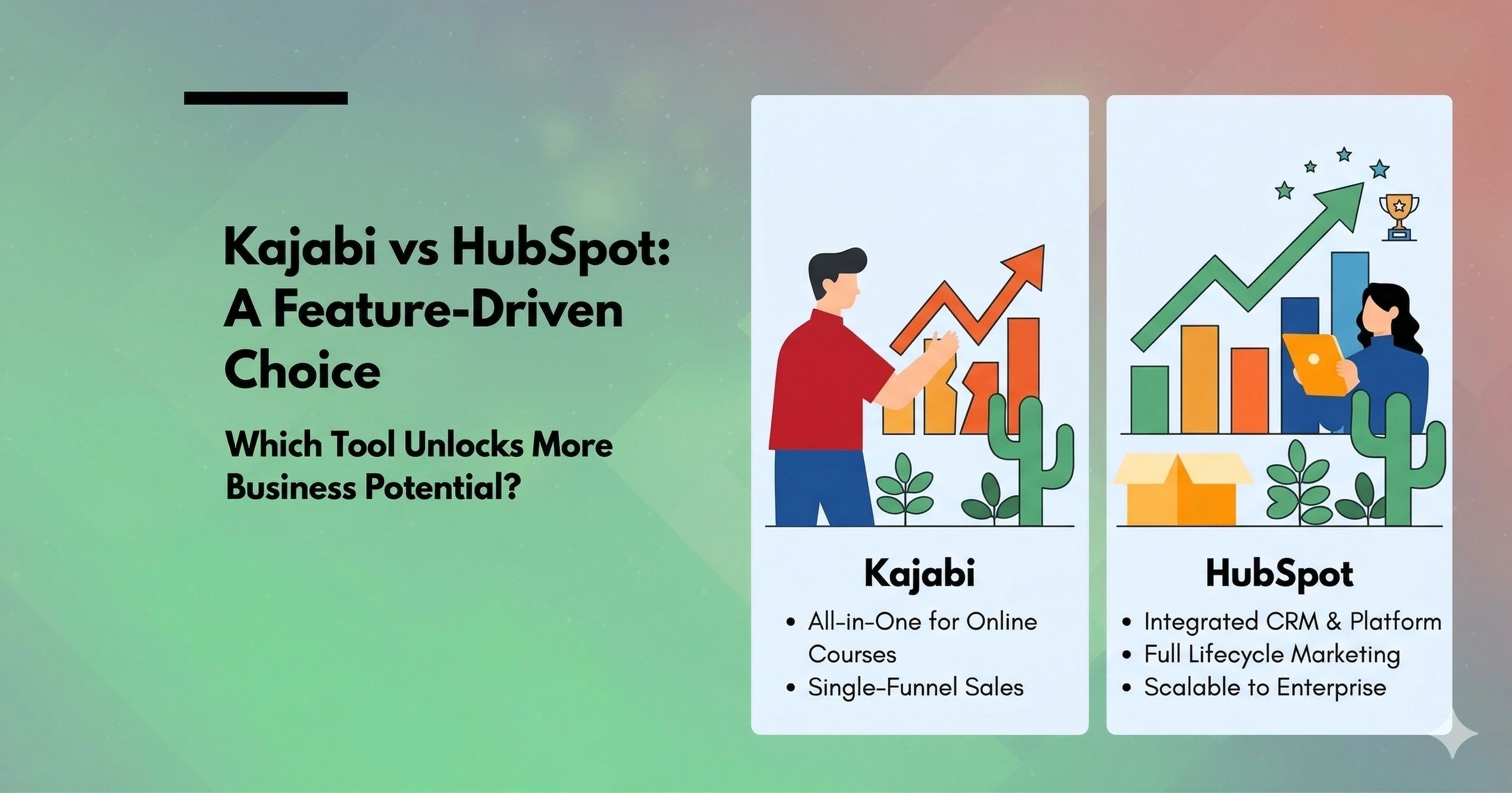
5. Six Questions That Tell You Which Platform You Need
1. Are you selling knowledge, expertise, or access to you?
Courses, coaching, memberships, communities - if your revenue comes from what you know, Kajabi was built for your business model. HubSpot was not.
2. Do you have a sales team managing prospects?
If you have sales reps working leads through a pipeline, HubSpot's CRM, lead scoring, and conversation intelligence create genuine operational value. Kajabi has no equivalent.
3. Is inbound marketing your primary growth strategy?
For businesses running SEO, content marketing, and lead nurturing at scale - HubSpot's marketing automation depth is harder to replicate. For creators who grow through content, community, and launches - Kajabi's all-in-one approach covers the essentials cleanly.
4. How many tools are you currently stitching together?
If you are paying separately for a course platform, email tool, landing page builder, community platform, and checkout tool - Kajabi replaces all of them. That consolidation has real financial and operational value for the best platform for online coaches and creators 2026.
5. Do you need B2B revenue reporting?
Pipeline reporting, deal forecasting, multi-touch attribution across marketing and sales - these are HubSpot capabilities with no Kajabi equivalent. For businesses where revenue reporting across a sales team matters, that gap is real.
6. Are you one person or a team?
Kajabi is priced for creators - one subscription covers everything regardless of how many students or members you have. HubSpot is priced per seat, meaning costs grow as your team grows.
[If you are evaluating the full HubSpot platform beyond service, our HubSpot vs Zendesk comparison covers the enterprise picture in detail.]() 
6. Can You Use Both? When It Makes Sense
There are businesses where both platforms make sense - and it is worth acknowledging that honestly.
A coach or expert who has built a significant creator business on Kajabi and is now building a B2B consulting arm might need HubSpot's CRM for the pipeline side while keeping Kajabi for their courses and community. An agency that creates courses as a lead generation tool might run HubSpot as the primary CRM and Kajabi for educational product delivery.
These scenarios exist. They are not common, but they are not wrong either. If your business genuinely spans both models, running both platforms with a Zapier or native integration between them is a legitimate approach - just be clear-eyed about the added cost and complexity before you commit.
7. Honest Answers to Common Questions
What is the main difference between HubSpot vs Kajabi in 2026?
HubSpot is a CRM and marketing platform built for businesses managing sales pipelines, marketing campaigns, and customer relationships. Kajabi is a creator commerce platform built for coaches, course creators, and experts who sell knowledge. The HubSpot vs Kajabi question is really about business model - not features.
Is Kajabi good enough for marketing automation?
For creator businesses, yes - Kajabi includes email marketing, automations, funnels, and segmentation that covers the essentials well. For complex B2B marketing automation with multi-touch attribution and advanced behavioral triggers, HubSpot's Marketing Hub goes significantly deeper.
Does Kajabi have a free plan?
No - Kajabi doesn't offer a free plan. It offers a free trial (typically 14 days on the website, sometimes 30 days through promotional links). The entry-level Basic plan starts at $143/month billed annually.
Is HubSpot worth it for course creators?
For most course creators, no - HubSpot does not include the tools a knowledge business actually needs (course hosting, community, membership management), and its pricing starts significantly higher. For the best platform for online coaches and creators 2026, CRM Discount shows Kajabi is the more natural fit. HubSpot becomes worth it when the creator business has grown to include a B2B sales motion with a dedicated team.
What makes Kajabi's Cofounder AI different from other AI tools?
Cofounder has access to your actual Kajabi business data - your products, your audience, your sales history, your existing content. When it gives you advice on pricing, positioning, or what to build next, it is drawing on your specific context - not generic internet training data. Looking at HubSpot vs Kajabi for course creators specifically, this context-aware business intelligence is something HubSpot's Breeze doesn't replicate for the creator use case.
8. The Clearest Way to Think About This
HubSpot vs Kajabi is not really a competition. They are built for different businesses, and trying to make one do the other's job creates friction that compounds over time.
If you are a coach, course creator, consultant, or expert building a business around your knowledge - Kajabi gives you everything you need under one roof, with AI that actually knows your business, at pricing that makes sense for a creator operation.
If you are running a B2B or mixed business with a sales team, a marketing function, and the need to manage customer relationships at scale - HubSpot's depth, unified data model, and revenue intelligence are worth the investment.
The platforms aren't competing for the same customer. They are serving different kinds of ambition.
The right platform saves you months of frustration and thousands in switching costs. Find yours now.
See what your HubSpot year one should cost
Two minutes with the assistant gets you an itemized estimate. A free 20-minute call gets you a yes or a no on taking your onboarding fee to $0 — plus the negotiation tips for a deal your size.
Book a free 20-minute callNo obligation. Independent — not a HubSpot partner. Run by RevOps operators whose agency is a certified HubSpot Solutions Partner.
Keep reading
What HubSpot's onboarding fee actually buys you
HubSpot's mandatory onboarding fee runs from $1,500 to $7,000 depending on the hub and tier. Here is what is inside it, when it is worth paying, and the two situations where a partner can deliver the same scope instead.

Annual vs Monthly CRM Plans: Which Saves You More Money Long-Term
Annual CRM billing saves 15-40 percent, but locks you in. The real numbers per platform, when the discount is worth it, and when monthly is the safer buy.